Choosing a sober living home is one of the most consequential decisions a family will make during the recovery process. It’s also one of the most confusing. There’s no universal regulation, the terminology changes from state to state, and the gap between the best and worst facilities is enormous.
This guide is meant to cut through that noise. Whether you’re a family member researching options, someone preparing for discharge, or a case manager vetting facilities, what follows is a practical framework for separating the places that’ll support recovery from the places that could put it at risk.
The Problem Nobody Warns You About
Here’s a reality most people discover too late: in most states, anyone can open a sober living home. No license required. No inspection. No minimum staffing standard. Someone can rent a house, drop beds in the rooms, and start accepting residents tomorrow.
Your Next Chapter — Life After Treatment
- Chapter 1: What Happens After Detox? A Complete Guide to Your Recovery Options
- Chapter 2: Why Sober Living Is the Missing Piece in Most Recovery Plans
- Chapter 4: Sober Living and IOP/PHP: Why the Combination Works
- Chapter 5: What Does a Day in Sober Living Actually Look Like?
- Chapter 6: When Addiction Costs You Your Career: Rebuilding More Than a Résumé
- Chapter 7: Beyond the Job Title: Rediscovering Purpose After Addiction
That means “sober living” covers an extraordinarily wide range. On one end, you’ve got state-licensed, professionally staffed residences with structured programming and clinical coordination. On the other, overcrowded houses with no accountability and operators more interested in collecting rent than supporting recovery.
The consequences of choosing wrong are serious — financial exploitation, unsafe conditions, inconsistent drug testing, and in the worst cases, environments where active use is tolerated. You can protect yourself. But it takes knowing what to look for.
Understanding the NARR Level System
The National Alliance for Recovery Residences (NARR) provides the most widely recognized framework for classifying sober living homes. NARR doesn’t certify individual residences directly — it charters state-level affiliates that handle the review and inspection process.
The system defines four levels, each with different staffing, governance, and services:
| Governance | Staffing | Services | |
|---|---|---|---|
| Level I: Peer-Run | Democratically run by residents (e.g., Oxford House) | No paid staff; residents share duties | Self-help meetings, peer support |
| Level II: Monitored | House manager or senior resident oversees operations | Part-time house manager | Life-skills coaching, mandatory meetings |
| Level III: Supervised | Organization or non-profit oversight | Certified staff and case managers on-site | Structured recovery programming, outpatient coordination |
| Level IV: Service Provider | Licensed clinical or treatment provider | Credentialed clinical staff 24/7 | On-site clinical services (PHP/IOP) |
Figuring out which level you need is the first step. Someone stable in recovery who’s highly self-directed might thrive in a Level I or II setting. Someone stepping down from inpatient or PHP — especially a professional who needs structured coaching and clinical coordination — will typically need a Level III.
The level determines how much support is woven into your day. A Level I home is basically a group of peers holding each other accountable. A Level III has certified staff, structured programming, and formal relationships with outpatient providers. Big difference.
Why State Licensing Matters More Than You Think
NARR certification is an important quality signal. But here’s something most families don’t realize: it’s voluntary. NARR sets quality standards, but it can’t shut anyone down. A certified home that violates its own standards faces reputational consequences, not legal ones.
State licensing is different. In Pennsylvania, DDAP licenses recovery houses and has actual enforcement power — fines, corrective action requirements, mandatory inspections, and in serious cases, the ability to shut a facility down.
State licensing also requires things that voluntary certification can’t mandate:
- Criminal background checks for all staff through state police
- Transparent fee structures — no hidden charges
- Fire safety requirements: fire-retardant mattresses, functioning smoke and CO detectors
- Building code compliance with regular inspections
- Public inspection records families can request and review
Studies show residents in state-licensed facilities have significantly lower substance use rates than those in unregulated settings. The smartest approach: look for both NARR certification and state licensing. Quality standards backed by legal teeth.
Red Flags That Should End the Conversation
When you’re touring or evaluating a sober living home, certain warning signs should stop you cold. If you hit any of these, walk away:
Immediate Safety Concerns
- No state license displayed or available on request
- Can’t provide a license verification number
- Bedrooms with more than two residents
- Dirty conditions or obvious deferred maintenance
- No working smoke or carbon monoxide detectors
Staff and Oversight Red Flags
- Staff can’t clearly explain licensing status
- No evidence of background checks
- No written house rules or resident handbook
- High turnover, no alumni engagement
- Inconsistent or missing drug testing
Financial Red Flags
- Vague or shifting fee structures
- Asking for government benefit cards or passwords
- No written contracts before admission
- Cash-only, no documentation
- Pricing that seems too good to be true
Any facility that gets defensive when you ask these questions is telling you everything you need to know. Legitimate operators welcome the scrutiny.

The Questions You Should Ask on Every Tour
Come prepared. These are the questions that separate quality facilities from everything else:
Licensing and credentials: What’s your DDAP license number? When was your last state inspection — can I see the report? Do all staff pass criminal background checks? Any current violations?
Programming and support: How do you tailor the program to someone’s career and personal goals? What coaching is available? How do you coordinate with IOP/PHP providers? What outcomes do you track?
Environment and community: What amenities support whole-person wellness? How are families involved? How do you build peer connection? What does aftercare look like six months out?
How to Verify Licensing Before You Visit
Don’t take a facility’s word for it. Before you even schedule a tour, check their licensing independently.
In Pennsylvania, you can verify any facility at sais.health.pa.gov. Search by name or location and confirm the “Recovery House” license is active. You can also call PA’s Get Help Now line at 1-800-662-HELP.
If a facility doesn’t show up in the database, ask them why. There might be a legitimate reason, but in Pennsylvania, licensure is the standard you should expect.
Making the Decision
Don’t rush this. Visit multiple facilities if you can. Talk to current or former residents. Bring your treatment team into the conversation. And trust your gut — if something feels off during a tour, it probably is.
The right place will feel like somewhere your loved one can actually heal and rebuild. The staff will be transparent, the residents engaged, the environment clean and professional. You’ll leave feeling more confident, not more confused.
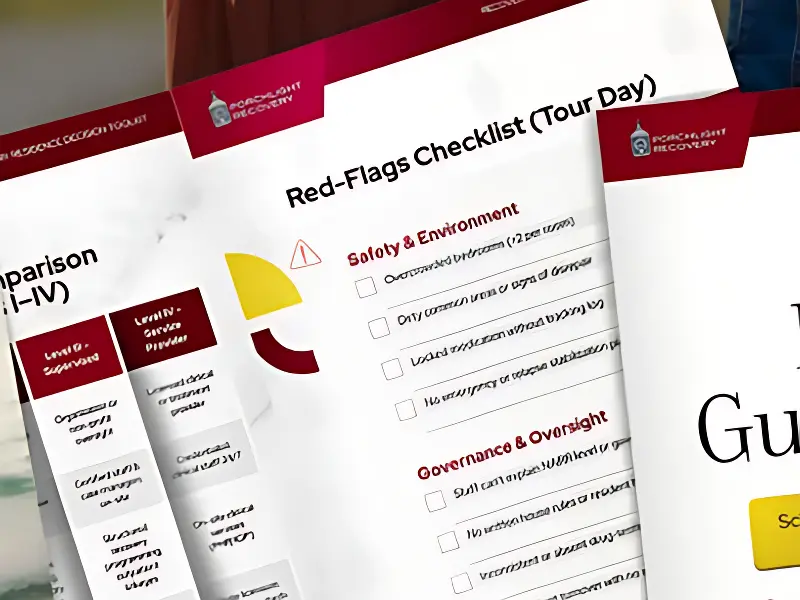
We put together a comprehensive, printable toolkit that covers everything in this article in a format you can bring on tours: the NARR level comparison, the red flags checklist, interview questions, and licensing verification steps. It’s free and available on our website.