Completing detox is one of the bravest decisions a person can make. Your body’s been through a grueling process — clearing out substances, managing withdrawal, stabilizing physically. You should feel proud of that.
But unfortunately, here’s the part most people aren’t prepared for: detox isn’t treatment. It’s the starting line.
Research from the National Institute on Drug Abuse is blunt: detoxification alone, without subsequent treatment, generally leads to a return to substance use. Studies show that 40 to 60 percent of people with substance use disorders will relapse at some point, and the risk is highest in the first few months after detox. For opioid use disorders specifically, one study found that 80 percent of patients relapsed within a month of discharge when no continuing care was in place.
That’s not meant to scare you. It’s meant to help you plan. Because the single biggest factor in whether someone sustains their recovery is what they do next.
This guide walks you through every option available after detox so you — or someone you love can make an informed decision about the right next step.
Your Next Chapter — Life After Treatment
- Chapter 2: Why Sober Living Is the Missing Piece in Most Recovery Plans
- Chapter 3: How to Choose the Right Sober Living Home: What to Look For (and What to Avoid)
- Chapter 4: Sober Living and IOP/PHP: Why the Combination Works
- Chapter 5: What Does a Day in Sober Living Actually Look Like?
- Chapter 6: When Addiction Costs You Your Career: Rebuilding More Than a Résumé
- Chapter 7: Beyond the Job Title: Rediscovering Purpose After Addiction
Understanding the Recovery Continuum
Recovery isn’t a single event. It’s a continuum of care, and each level of support serves a different purpose depending on where someone is in their journey. Think of it as a series of steps, each one building on the last, giving you more independence while keeping the right amount of structure in place.
What follows are the primary options after detox, ordered from the most intensive to the most independent.
Inpatient Residential Treatment
Inpatient residential treatment — sometimes just called rehab — is the most structured option after detox. You live at the facility full time, typically for 30 to 90 days, and participate in a daily schedule of individual therapy, group sessions, educational programming, and wellness activities.
This level of care is often recommended for people with severe substance use disorders, co-occurring mental health conditions, or limited support systems at home. It removes you entirely from your environment and gives you space to focus exclusively on recovery.
Best for: people who need 24/7 clinical supervision, those with a history of multiple relapses, or anyone whose home environment poses a real risk to sobriety.
Partial Hospitalization Program (PHP)
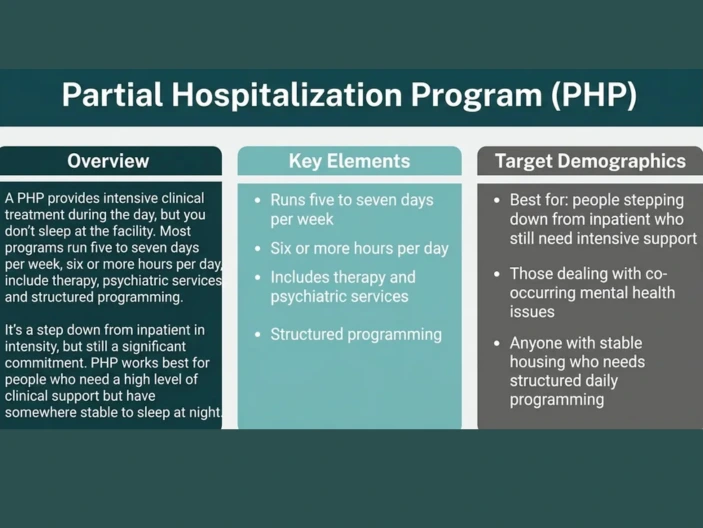
A PHP provides intensive clinical treatment during the day, but you don’t sleep at the facility. Most programs run five to seven days per week, six or more hours per day, and include therapy, psychiatric services, and structured programming.
It’s a step down from inpatient in intensity, but still a significant commitment. PHP works best for people who need a high level of clinical support but have somewhere stable to sleep at night.
Best for: people stepping down from inpatient who still need intensive support, those dealing with co-occurring mental health issues, or anyone with stable housing who needs structured daily programming.
Intensive Outpatient Program (IOP)
IOP provides structured treatment — usually three to five days per week, three to four hours per session. It includes group therapy, individual counseling, and skill-building workshops, but it lets you maintain your work schedule, family responsibilities, and daily routine.
This is one of the most common next steps after detox, especially for professionals and working adults who can’t take an extended leave. You get clinical support without putting your entire life on hold.
Best for: working professionals who need to keep their jobs, people stepping down from inpatient or PHP, anyone who needs flexibility around career or family commitments.
Sober Living: The Bridge Most People Skip
This is where the recovery continuum has a critical gap — and it’s the one most people don’t know about until it’s too late.
After detox, after inpatient, after completing an IOP or PHP, many people go straight home. Back to the same environment, the same patterns, the same pressures that were part of the problem in the first place. But unfortunately, that’s exactly when people are most vulnerable, and the data tells the rest of the story: relapse rates spike.
A sober living residence is a structured, substance-free living environment that bridges the gap between treatment and independent living. It’s not a treatment center. It’s not a halfway house in the way most people imagine. A quality sober living home provides accountability, community, coaching, and the daily structure that gives people time and space to actually practice the skills they learned in treatment.
The research on this is striking. A 2022 study in the Journal of Substance Abuse Treatment found that people living in structured sober living during outpatient care were twice as likely to complete their treatment successfully — and stayed in care an average of 66 days longer than those who didn’t. An earlier study showed sober living residents had higher abstinence rates, greater employment gains, and fewer arrests over 18 months.
Sober living works because it addresses the part of recovery that clinical treatment can’t: what happens when you walk out the door. How do you handle a Friday night? How do you manage work stress without reaching for a substance? How do you rebuild relationships that took a beating during active addiction? You don’t learn these things in a therapy session. You practice them, day after day, surrounded by people who get it.
Ready to see it for yourself? Schedule a tour or call 833-799-6500.
How These Options Work Together
Something that surprises a lot of people: these options aren’t mutually exclusive. The most effective recovery plans actually combine multiple levels of care.
The most common — and most effective — combination looks like this:
| Phase | What It Provides | Typical Duration |
|---|---|---|
| Detox | Medical stabilization, safe withdrawal management | 3–10 days |
| Inpatient / PHP | Intensive clinical therapy, psychiatric care, structure | 30–90 days |
| IOP + Sober Living | Ongoing clinical support combined with a structured, substance-free living environment | 90 days – 1 year |
| Independent Living | Aftercare support, alumni community, ongoing meetings | Ongoing |
Look at that third row. The combination of IOP or PHP with sober living is where the research shows the strongest outcomes. You get clinical treatment during the day, and you come home to an environment that supports your recovery at night. Triggers don’t disappear just because you’re in sober living — but the right environment, like PorchLight or other licensed facilities, helps you address those triggers in real time, surrounded by peers and coaches who understand what you’re facing. That’s a fundamentally different experience than white-knuckling it alone in an apartment.
Not All Sober Living Homes Are Created Equal
This matters, and we’ll cover it in depth later in this series. But the short version: the sober living industry is largely unregulated in most states. Anyone can rent a house, put a few beds in it, and call it sober living.
That’s why it matters whether a facility is state-licensed and certified by a recognized organization. In Pennsylvania, the Department of Drug and Alcohol Programs (DDAP) licenses recovery houses. The National Alliance for Recovery Residences (NARR) provides a voluntary certification system that classifies homes into four levels based on structure and services.

When you’re evaluating any sober living home, ask about:
- State licensing and certification status
- Staff qualifications and background check requirements
- Drug testing protocols and accountability measures
- The level of coaching or programming included
- Coordination with IOP/PHP providers
- Privacy protections, especially for licensed professionals
- What aftercare and alumni support looks like
A quality facility should answer every one of these without hesitation. If they can’t — or if they get defensive when asked — that tells you everything you need to know.
What to Do Right Now
If you or someone you love is approaching the end of detox or an inpatient program, the most important thing you can do is have a plan in place before discharge day. Don’t wait until you’re standing at the front door with a bag in your hand to figure out what’s next.
The Decision That Changes Everything
Detox saved your life. What you do next determines the quality of that life.
The people who sustain their recovery long-term aren’t the ones who white-knuckle it alone. They’re the ones who surround themselves with structure, accountability, and community during the most vulnerable stretch of their journey. They give themselves permission to take the time they need.
If you’re exploring what comes after detox — for yourself or someone you care about — we’re here to help you think through the options. No pressure, no sales pitch. Just an honest conversation about what the right next step looks like for your situation. Or start your application today if you’re ready to move forward.
FAQs
Your Next Chapter — Life After Treatment
- Chapter 2: Why Sober Living Is the Missing Piece in Most Recovery Plans
- Chapter 3: How to Choose the Right Sober Living Home: What to Look For (and What to Avoid)
- Chapter 4: Sober Living and IOP/PHP: Why the Combination Works
- Chapter 5: What Does a Day in Sober Living Actually Look Like?
- Chapter 6: When Addiction Costs You Your Career: Rebuilding More Than a Résumé
- Chapter 7: Beyond the Job Title: Rediscovering Purpose After Addiction