
BEYOND RECOVERY | PART 2 OF 5
The answer may become one of recovery’s most meaningful opportunities.
When the Job Title Becomes Your Identity
Professional achievement often reflects years of dedication, sacrifice, and responsibility. Work can provide financial independence, community, personal satisfaction, and a sense of contribution.
Losing that role can affect much more than income. It can disrupt routines, relationships, professional confidence, and a person’s understanding of where they belong.
These losses deserve acknowledgment. Recovery does not require pretending they never mattered.
But a job title is only one expression of someone’s abilities, values, and potential.
Your career may change. Your value does not.

Your past deserves acknowledgment. Addiction can change the course of a career, but it doesn’t have to define your future.
Why Purpose Matters in Recovery
The Substance Abuse and Mental Health Services Administration identifies four interconnected dimensions of recovery: health, home, purpose, and community.
Purpose includes meaningful daily activities such as employment, education, volunteering, family responsibilities, and creative pursuits. It also involves the independence and resources needed to participate in society.
This distinction matters. Recovery is not measured solely by returning to work. It involves building a life that feels meaningful and sustainable.
Researchers describe the personal, social, and community resources that support recovery as recovery capital. These resources can include stable housing, supportive relationships, practical skills, education, and employment opportunities.
Someone may complete treatment and still face significant challenges involving housing, finances, relationships, or professional identity. Clinical care remains essential, but meaningful support often extends beyond the treatment setting.
Recent research is helping clarify why.
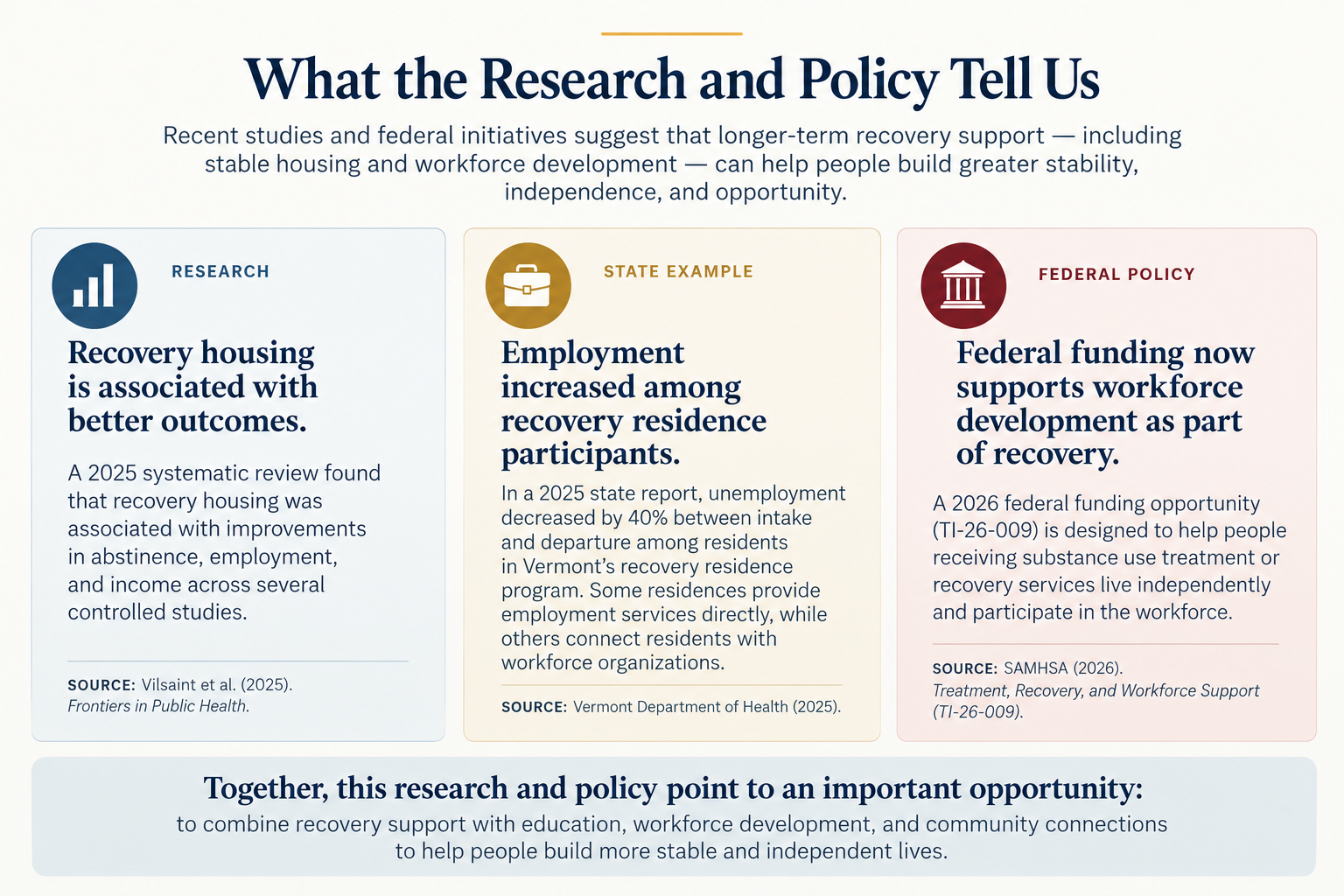
A 2025 systematic review published in Frontiers in Public Health examined recovery housing studies and identified promising findings involving abstinence, employment, and income, while recognizing limitations in the available evidence.
A 2025 Vermont recovery-residence report documented a decline in unemployment among participating residents between intake and departure. The findings are observational and do not establish that recovery housing or employment services caused the improvement.
Federal policy is also recognizing the relationship between recovery and economic independence. In 2026, the federal Treatment, Recovery, and Workforce Support funding opportunity explicitly connected substance use treatment and recovery services with independent living and workforce participation.
Together, these developments point toward an important question: What happens after someone achieves stability in recovery, but still needs to rebuild a meaningful professional life?
Your Experience Still Has Value
Consider a healthcare professional who can no longer practice in the same capacity, a commercial driver whose license has been affected, or a supervisor who has lost a position built over decades.
Their professional circumstances may have changed. Their experience has not disappeared.
Leadership, communication, problem-solving, technical knowledge, mentoring, and sound judgment can remain valuable in different settings.
A former executive may bring strengths in operations and business development. A skilled tradesperson may be able to train or mentor others. A first responder may possess experience in crisis management and working under pressure.
The challenge is recognizing these abilities beyond the job title with which they were once associated.
Three questions can help begin that process:
- What have I learned? Identify skills and knowledge developed through work, education, relationships, and life experience.
- What still matters to me? Consider the values, activities, and relationships that create meaning.
- Where might those strengths make a difference now? Explore opportunities without assuming the next chapter must resemble the last.

Your experience still has value. The skills, knowledge, and determination you’ve developed don’t disappear when your career changes.
Purpose Doesn’t Always Begin With a Paycheck
After a career setback, the instinct may be to rebuild quickly: find another position, restore income, and demonstrate that everything is back on track. Those goals are understandable. But meaningful progress does not always follow a straight line.
Sometimes the first step is mentoring someone, returning to school, volunteering, exploring entrepreneurship, or rebuilding relationships that received too little attention during years of demanding work.
These activities can restore structure, strengthen community connections, and help someone recognize what they want from the next stage of life.
Instead of asking only, What position do I hold? a person may begin asking, What contribution am I making?
This does not mean abandoning professional ambition. It means allowing ambition to evolve.
From Recovery to Opportunity
One of the important questions facing the addiction recovery field is whether we are doing enough to support individuals after clinical stabilization—particularly when their previous careers are no longer available to them.
Research on recovery housing and emerging workforce initiatives suggests there is value in exploring more connected approaches to housing, treatment, education, employment, and community support.
A 2024 MDRC report, Providing Employment Services to Individuals in Recovery, examined a Kentucky program that integrates residential addiction recovery services with job-readiness training, internships, and occupational certifications. Although the report does not establish the program’s effectiveness, it provides a practical example of how recovery services and workforce preparation can be brought together.
This broader perspective is helping shape our thinking at PorchLight Recovery.
We are developing PorchLight Pathways, an initiative envisioned to help bridge the space between recovery and renewed educational, vocational, and professional opportunity.
The goal is not to prescribe a single career path or promise employment. It is to explore how meaningful connections, practical resources, and opportunities for continued development can complement the stability of recovery.
For someone with decades of professional experience, the next opportunity may involve applying familiar skills in a different setting. For someone considering a new field, education or vocational training may open a door. And for someone still discovering what matters, the first step may simply be having the support and confidence to explore.

Your future still holds possibility. Through connection, mentorship, and meaningful opportunity, a new professional chapter can begin.
Your Next Chapter Is Yours to Define
PorchLight’s 100 Action Principles reflect a philosophy of personal responsibility, resilience, and purposeful action.
One idea is especially relevant here:
Your past is part of your story, not the limit of your future.
This does not diminish the consequences of addiction or the responsibility that comes with recovery. It recognizes that a difficult chapter need not determine every chapter that follows.
A meaningful future may involve returning to a former profession, changing careers, completing a degree, starting a business, or discovering fulfillment through service and relationships.
There is no single definition of success that applies to everyone.
The opportunity is to recognize the value that remains, identify what matters now, and take deliberate steps toward a future worth building.
Recovery is the beginning. Opportunity is the destination.
This is Part II of PorchLight Recovery’s five-part Beyond Recovery series. Read Part I: When Addiction Costs You Your Career to explore how professional experience and identity can survive career disruption.










Leave A Comment