
As federal policy shifts toward treatment and recovery, behavioral health professionals face important questions about the role of structured recovery housing, continuity of care, and the environments that support long-term recovery.
The national conversation about homelessness, addiction, and mental health is changing. With the federal government moving toward a Treatment First approach, a familiar debate has returned: Should we prioritize housing without conditions, or should treatment and recovery be part of the pathway to stable housing? It’s an important discussion, but I believe we’re overlooking a critical piece of the recovery process.
For people living with substance use disorders, housing isn’t simply a matter of having a roof over their heads. The environment we return to after treatment, the people we’re surrounded by, and the support available when life becomes difficult can have a profound impact on our ability to sustain recovery.
At PorchLight Recovery, we operate professionally supervised recovery housing in Lancaster, Pennsylvania. Our work is centered on a straightforward principle: people deserve a dignified place to live, meaningful accountability, and the opportunity to rebuild their lives within a supportive community. As policymakers reconsider the relationship between housing and treatment, professionally operated recovery residences deserve a meaningful place in that conversation.
Understanding Housing First and Treatment First
Housing First prioritizes placing people experiencing homelessness into stable housing without requiring sobriety, employment, or participation in treatment as a condition of entry. Supportive services are offered, but participation is generally voluntary. The underlying premise is that people are better positioned to address addiction, mental illness, and other challenges when they aren’t simultaneously struggling to find somewhere safe to sleep.
Treatment First takes a different approach. It places greater emphasis on engaging people in treatment and connecting housing with recovery services, behavioral health support, and pathways toward self-sufficiency.
Both approaches address legitimate concerns. Housing instability can make it extraordinarily difficult to engage in treatment. At the same time, someone leaving an intensive treatment program may need considerably more support than an apartment and occasional contact with a case manager. These aren’t necessarily competing needs. They’re different challenges that require different responses.
What Is the Difference Between Housing First, Treatment First, and Recovery Housing?
Housing First prioritizes access to stable housing without requiring sobriety or treatment participation. Treatment First links housing opportunities to treatment engagement or recovery-related requirements. Recovery housing offers substance-free living environments with varying levels of peer support, structure, and professional supervision for people pursuing recovery.
| Approach | Primary Focus |
|---|---|
| Housing First | Housing stability without treatment prerequisites |
| Treatment First | Treatment engagement and recovery-related housing pathways |
| Recovery Housing | Recovery-supportive living with varying levels of structure |
Why the debate matters right now
In September 2026, the Substance Abuse and Mental Health Services Administration announced $42.3 million in supplemental funding to advance the federal government’s Treatment First initiative.
Of that amount, $25 million was awarded through substance use prevention, treatment, and recovery block grants to help states and territories expand the availability of safe, licensed, certified, or chartered recovery housing. Another $17.3 million was directed toward mental health-related infrastructure, training, and coordination. These changes are unfolding alongside broader debates about federal homelessness policy and the future of HUD’s Continuum of Care program
The announcement represents a significant policy development for the recovery housing industry.
For years, recovery residences have occupied an important but sometimes underrecognized position within the continuum of care. They provide an environment where people can practice the skills developed during treatment while navigating employment, family relationships, financial responsibilities, and everyday life.
The federal government’s increased attention to recovery housing creates opportunities to expand access and strengthen quality standards. It also raises questions about funding, oversight, and how to ensure that people who need housing aren’t excluded because they aren’t yet ready to enter treatment.
What does the research tell us?
A 2025 systematic review published in Frontiers in Public Health examined research on recovery housing for individuals with substance use disorders. Across five eligible studies, researchers found that recovery housing generally produced better outcomes than usual continuing care or no intervention in areas including abstinence, income, and employment. Some studies also demonstrated improvements in criminal justice outcomes and cost-effectiveness. The researchers rated the overall evidence as moderate, noting that more high-quality studies are needed, particularly across different types of recovery housing. This is encouraging, but we should be careful about what the research does and doesn’t establish.
Recovery housing and Housing First often serve different populations and measure different outcomes. Housing First research has demonstrated benefits in housing stability, while the recovery housing literature has focused more directly on substance use, employment, and recovery-related outcomes. We need more research examining how these approaches can work together, particularly for people with complex behavioral health needs.
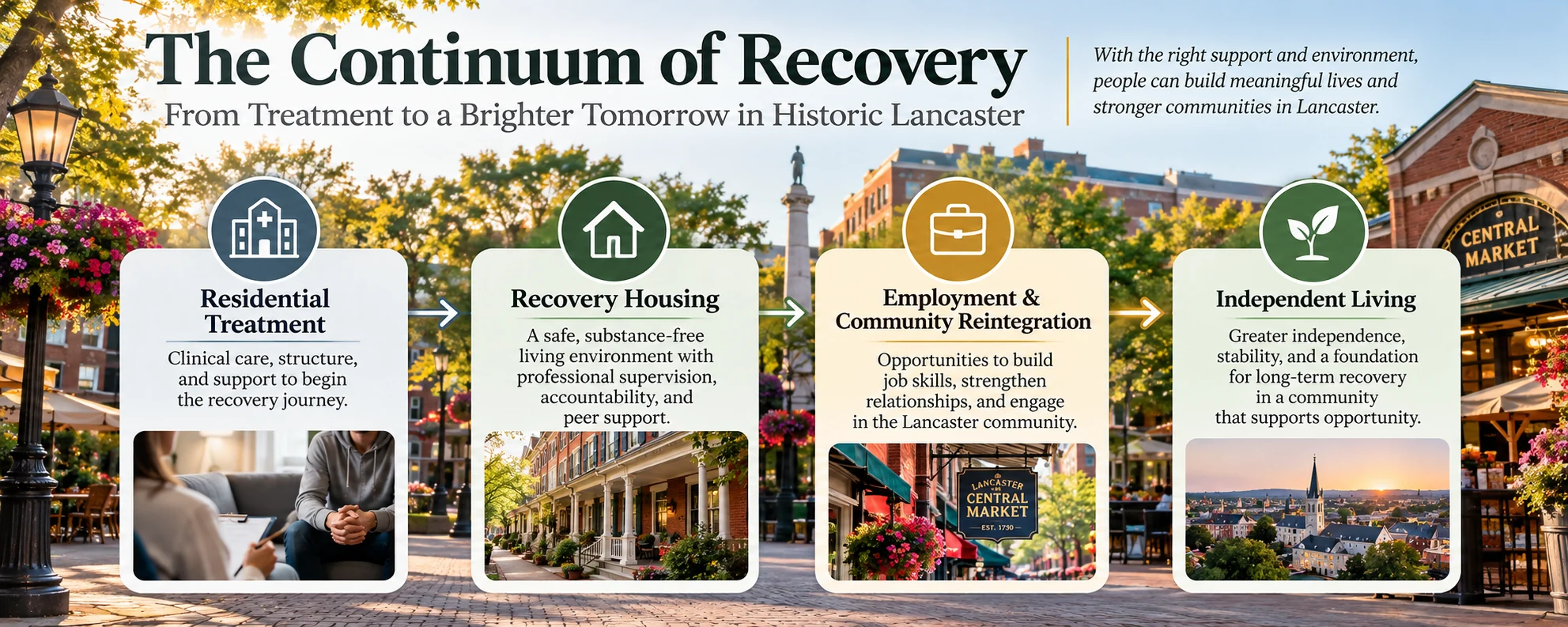
The missing piece: What happens after treatment?
Why Historic Lancaster Matters to Recovery
At PorchLight Recovery, we believe the environment surrounding recovery matters. Historic Lancaster offers something particularly valuable to individuals looking for a fresh start: walkable neighborhoods, access to outpatient treatment, employment opportunities, and a community where meaningful connections can develop. Our professionally supervised residences provide the structure and accountability residents need while they begin building more independent lives.
Professional standards matter
As funding and public attention shift toward recovery housing, we need to be equally focused on the quality of the housing being offered.
Not all sober living environments provide the same level of supervision, structure, or resident support.
The National Alliance for Recovery Residences identifies four levels of recovery housing, ranging from peer-operated environments to residences offering more intensive services.
At PorchLight Recovery, our NARR Level III model emphasizes supervised housing, structured programming, accountability, and connections to outside treatment and recovery resources. NARR has developed these professional recovery housing standards to ensure best in class practices are in .
For families and referral professionals, these distinctions matter.
A person transitioning from a higher level of care may benefit from professional oversight and a structured environment. Another individual, further along in recovery, may thrive in a more independent peer-supported residence.
Housing decisions should reflect individual needs rather than assuming one model is appropriate for everyone.
Quality standards should also address resident rights, medication policies, safety, ethical operations, and appropriate responses when someone experiences a recurrence of substance use.
In particular, people receiving prescribed medications for opioid use disorder should not face blanket exclusion from recovery housing simply because they are receiving evidence-based treatment.
Frequently Asked Questions About Recovery Housing
What should discharge planners look for in recovery housing?
Discharge planners should evaluate a residence’s level of supervision, staff qualifications, recovery support, medication policies, safety procedures, and coordination with outpatient treatment providers. The appropriate residence depends on the individual’s clinical needs, recovery goals, and readiness for independent living.
What is NARR Level III recovery housing?
NARR Level III recovery residences provide supervised, structured recovery housing with organizational oversight, trained staff, peer support, and recovery-oriented services. They offer more structure than peer-run housing but are not a substitute for licensed clinical treatment. Learn more about PorchLight Recovery’s NARR Level III housing model.
Can someone receiving medication for opioid use disorder live in recovery housing?
Yes. PorchLight Recovery welcomes individuals receiving prescribed medications for opioid use disorder (MOUD), including buprenorphine, methadone, and naltrexone. We recognize these medications as evidence-based treatment and support residents in continuing their prescribed care while participating in our structured recovery housing program. Our medication policies are designed to comply with applicable federal requirements, including the Americans with Disabilities Act (ADA), while maintaining a safe and supportive living environment.
Recovery means more than abstinence
One area I believe deserves considerably more attention is how we define success.
Abstinence is an important outcome for recovery-oriented housing, but it’s not the only measure of a person’s progress.
Are residents reconnecting with their families? Are they finding meaningful employment? Are they developing financial independence? Are they building healthy relationships and participating in their communities?
And perhaps most importantly, are they developing the stability and confidence necessary to live independently when they’re ready?
These are the outcomes that should help inform the next generation of recovery housing.
Through PorchLight Gives, we’re also exploring how workforce development and employment opportunities can become more closely connected to recovery support. The objective is to help individuals build lives that are sustainable well beyond their time in structured housing.
The affordability question we can’t ignore
Expanding access to quality recovery housing requires confronting an uncomfortable reality: many of the people who would benefit most from structured housing are least able to afford it.
Professionally operated residences have real expenses. Qualified staffing, property maintenance, safety, programming, and appropriate oversight all cost money.
Yet the funding available to cover these expenses remains limited and fragmented.
The new federal emphasis on recovery residences may create opportunities to address this problem, but funding needs to translate into sustainable programs, measurable outcomes, and greater access for people with limited financial resources.
We should also be careful not to create a system where access to stable housing depends entirely on a person’s ability or readiness to participate in treatment.
Someone who isn’t ready for a recovery residence still needs a safe place to live.
Moving beyond an either-or debate
I don’t believe we should approach housing and treatment as though one must come at the expense of the other. Housing First addresses an urgent need for people experiencing homelessness; whereas, recovery housing provides a specialized environment for people pursuing recovery from substance use disorders. Treatment programs provide clinical care that housing providers aren’t equipped to deliver independently. We need all three, along with better coordination between them.
The real opportunity is to develop a continuum in which individuals can access the right environment at the right time, with clear pathways between housing, treatment, employment, and independent living. As the federal government invests more heavily in recovery housing, I hope the discussion moves beyond simply counting available beds.
We should be asking what happens inside those residences, how effectively they support the people living there, and whether residents leave with a stronger foundation for long-term recovery. Because the ultimate objective isn’t simply to house someone or complete another episode of treatment, it’s to help people build lives they love and are worth sustaining.
Looking for professionally supervised recovery housing?
If you’re a treatment provider, interventionist, therapist, or discharge planner, connect with our team to learn more about PorchLight’s supervised recovery residences in Lancaster, Pennsylvania.
Leave A Comment