

Part 2 of 5 — “See Recovery as a Process, Not an Event”
Missed Part 1? Catch up on Principle #1 (“Own Your Decision”) here →
1. Why This Principle Matters
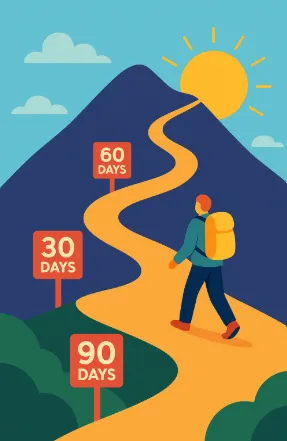
Recovery is less like a light-switch moment and more like a long-distance hike—complete with switchbacks, plateaus, and breathtaking overlooks. When residents expect ups and downs, they:
- stay engaged during inevitable motivation dips,
- interpret lapses as course-corrections (not failures), and
- build stamina for lifelong change.
A 2023 meta-analysis of 57 longitudinal studies found that clients who framed sobriety as an ongoing journey had 34 % higher 18-month abstinence rates than those who saw it as a one-time “fix.”
2. Brain-Based Rationale
- Neuroplasticity is gradual. Gray-matter volume in reward-pathway regions begins normalizing around three months of abstinence—and continues for years.
- Dopamine thresholds reset slowly. Viewing recovery as progressive keeps expectations realistic while the brain’s reward circuitry recalibrates.
- Stress-response systems desensitize over time. Each craving you surf strengthens pre-frontal inhibitory circuits, exactly like reps in the gym.
3. Map the Journey: The Three-Stage Recovery Curve
| Stage | Hallmarks | Common Pitfalls | Process Mindset Reminder |
|---|---|---|---|
| Early (0-90 days) | Pink-cloud highs, acute cravings, big lifestyle shifts | Over-confidence, “I’m cured!” thinking | “I’m starting the trail—pace yourself.” |
| Middle (3-12 months) | Routine settles in, motivation plateaus, brain fog clears | Boredom, comparing progress to others | “Plateaus are part of climbing—keep moving.” |
| Maintenance (1 yr +) | Identity shifts, stability grows, new goals emerge | Complacency, “social using” fantasies | “The view is great—keep tending the path.” |
Print this table and highlight where you are right now.
4. Four Ways to Live It Out This Week
| Action | Why It Works | How-To |
|---|---|---|
| Create a Progress Timeline | Visual progress combats “nothing’s changing” thinking. | On a single page draw month-by-month milestones: clean date, first meeting chaired, new job, etc. |
| Write a Future Letter | Projects hope beyond the current state. | Pen a letter from “You at 2 Years Sober” to your present self. Seal it for six months. |
| Adopt the “One-Percent Rule” | Small gains compound and feel doable. | Pick one micro-improvement (bed by 11:00 PM, 5-minute gratitude list) and track it seven days. |
| Schedule a Plateau Check-In | Pre-planned review prevents drift. | Add a calendar reminder 60 days out: “How’s my momentum? What do I tweak?” |
5. Obstacles & Quick Reframes
| Thought Trap | Reframe |
|---|---|
| “I should be further along by now.” | “Growth curves aren’t straight lines—progress compounds beneath the surface.” |
| “Everyone else is crushing it but me.” | “Social media hides their valleys. I’ll compare only to yesterday’s me.” |
| “A slip means I’m back at zero.” | “Data point noted—my learning is never reset to zero.” |
6. Reflection Prompts
- Plateau Audit: Where in life (fitness, finance, friendships) have you hit a plateau and pushed through? What strategies translated?
- Process Pride: List three ways you’ve grown beyond simple abstinence (e.g., conflict resolution, budgeting, morning routine).
- Next Switchback: What small habit change will give you momentum on the next bend of the trail?
Write responses in your journal, then share one insight with a peer or staff member this week.
Coming Up Next
Part 3: “Build a Vision Board”—We walk through a 30-minute, low-cost method for creating a board that trains your brain’s Reticular Activating System to spot recovery-aligned opportunities everywhere you go.